
March 1916
We look to find a Hospital a restful, quiet place,
With wards all hushed and silent - but that is not quite the case
In those which fling wide open doors for men who've borne the brunt,
And welcome them with outstretched arms; 'Our Wounded' from the Front.
You see a boy - he's little more - whose life has but begun,
Skylarking with an older man, whose years are nearly run.
The one mayhap has lost an arm, the other p'raps a leg;
'Are they downhearted?' No, not they, nor for your pity beg.
Some other man, with bandaged head, perhaps is passing by;
They chaff him, and he chaffs them back, and swift the words will fly.
The worst of wounds can't bring a groan, tho' teeth may be clenched tight;
'Our wounded' are the boys who at the Front put up a fight.
And those who cannot walk will each just sit him in a chair,
And race along the corridors to see who'll first be there.
You talk of gloom - not they - although they've freely risked their lives
That you and I may be in peace, with sisters, mothers, wives.
They're boys we're might proud of, but can scarce restrain a tear,
For oh! the wreck war's made of them, and many we hold dear.
They don't like to be pitied now they've done their valiant stunt,
For each and all are heroes, are 'our wounded' from the Front.
P. R. CRAFT, Cpl., R.A.M.C.(T.)
Thursday, 29 July 2010

Tuesday, 27 July 2010

Saturday, 24 July 2010
Hospital Notice Board
March 1916
CABLING TO AUSTRALIA - Members of the Australian Force desirous of sending cablegrams to their relatives and friends in Australia may do so at special cheap rates, which may be ascertained from the memorandum issued by the Australian War Contingent Association, 72, Victoria Street, S.W.
NEW ZEALANDERS will find information with regard to cabling, correspondence, accommodation in London, newspapers, pay, etc., in the N.Z. War Contingent Association's memorandum, which is exhibited in the Recreation Room.
THE ANZAC BUFFET - At the Australian Military Offices, 130, Horseferry Road, Westminster, S.W., there is an excellent little set of rooms known as the Anzac Buffet, where all 'Anzacs' are accorded a hearty welcome and may rest, read, write, and obtain refreshment. The Buffet is conducted by an energetic staff of Australian ladies.
AUSTRALIANS ON FURLOUGH who would like to spend their time, or a portion of their time, in country houses in England are asked to communicate with the Secretary of the Australian War Contingent Association, (72, Victoria Street, S.W.), as many offers of hospitality have been received.
SOUTH AFRICANS - All 3rd L.G.H. patients from South Africa are requested to send their names to the Hon. Treasurer, South African Contingent Comfort Fund, Bath House, Piccadilly, London, W., or to Sergt. Sumner, R.A.M.C. (T.) (a member of the staff of this hospital).
*****
Wednesday, 21 July 2010
Our Contributors
March 1916
So many friends outside the hospital now subscribe to The Gazette that we make no apology for printing a few paragraphs concerning our contributors. The majority of these are known throughout the 3rd L.G.H., but the general public is naturally curious to learn who they are and what position they hold in our community at Wandsworth.
Major Humphris (author of the 'Sparks' causerie) is well-known as an X-ray expert. He is temporarily absent from the 3rd L.G.H., his services having been required for the founding of X-ray departments in the Eastern Mediterranean. Capt. Harrison, whose alarming 'Labour-saving Devices' are continued this month, is in charge of our Pathological Laboratory, an article describing the work of which has been written by Pte. H. J. Gilby, one of his assistants.
From our first number onwards an ever-increasing chorus of praise has been showered on the very funny drawings by Pte. de la Bere. This month's series, 'An Orderlim's Day' (an orderlim is a male orderly, as distinguished from an orderlette), will sustain his reputation for a satire the full delicacy of which must sometimes, we are afraid, be missed by those unacquainted with the hospital's actual working. Pte. de la Bere, who was for five months in charge of D Ward (the Detention and Observation ward), and afterwards worked as an orderly in the Receiving Ward - the hall where newcomers and out-patients are attended to - has transferred to the Artists' Rifles. With him has gone Pte. J. A. Grant (illustrator of our Christmas shocker 'The Phantom Bride') but both have promised to continue to contribute.
Amongst other members of the R.A.M.C. (T.) unit who have sent illustrations are L-Cpl. George J. Coates, of the Recreation Room staff; Pte. Paul Kirk, a 'corridorderly'; Cpl. Fullwood of the Officers' Pack Store; Pte. Evans, dentist's orderly; and Pte. Ware, who made the drawing of the Royal Red Cross recently awarded to the Matron.

Aurelio Spaccatrosi, of whom L-Cpl. Coates has done a remarkable likeness, is certainly one of the most interesting patients passed through the 3rd L.G.H. Italian by birth (but long since naturalised), and a chef by profession, Pte. Spaccatrosi has seen many adventures. He was through the S.A. War, when he cooked for Lord Kitchener, Lord Roberts, and General Buller. In this war he has been at the Front in France; he then went to Lemnos, Suvla Bay, Salonika, and Egypt. On the Gallipoli Peninsula he carried on his art under conditions of the greatest danger and difficulty - but contrived to invent twenty different dishes made from bully beef. Pte. Spaccatrosi, who has had the honour of being presented to King George and Queen Mary, has four sons serving in the British Army. One of them, Albert, was in the retreat from Mons.
The bust of the C.O., which is on view in the new Recreation Room, and of which we publish a photograph, is universally pronounced to be a very fine likeness as well as a remarkable work of art. It was done by a member of our own staff, Sgt. Derwent Wood, who is head of the hospital's plaster splint-making department. Sgt. Derwent Wood is a sculptor of international celebrity, and the 3rd L.G.H. claims a unique advantage over the other war hospitals in possessing his services. The measure of his powers can be gauged by an examination of the bust to which we allude above (and we doubt whether the C.O. of any other hospital could find a member of his staff capable of thus immortalising him); but the splint room contains many very different specimens of a craftsmanship which, in a sense, are a still more significant tribute to Sgt. Derwent Wood.
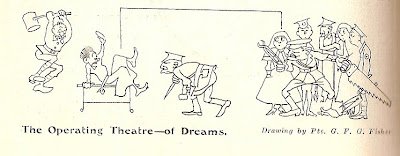
Maj. H. C. Taylor Young, the author of the Kangaroo Story, is an Australian surgeon on the staff of the 3rd L.G.H., and his illustrator, Pte. Vernon Lorimer is also the author of many pictures and headings. Pte. G. F. G. Fisher who drew the exquisitely humorous operating-theatre fantasy which appears as a tailpiece on page 158, was a B.4 patient, but recently left the hospital for a convalescent home at Weybridge.
Two lady members of the hospital's staff send drawings this month - Miss Marjory Collins and Miss V. Down. Both are ward orderlies.
So many friends outside the hospital now subscribe to The Gazette that we make no apology for printing a few paragraphs concerning our contributors. The majority of these are known throughout the 3rd L.G.H., but the general public is naturally curious to learn who they are and what position they hold in our community at Wandsworth.
Major Humphris (author of the 'Sparks' causerie) is well-known as an X-ray expert. He is temporarily absent from the 3rd L.G.H., his services having been required for the founding of X-ray departments in the Eastern Mediterranean. Capt. Harrison, whose alarming 'Labour-saving Devices' are continued this month, is in charge of our Pathological Laboratory, an article describing the work of which has been written by Pte. H. J. Gilby, one of his assistants.
From our first number onwards an ever-increasing chorus of praise has been showered on the very funny drawings by Pte. de la Bere. This month's series, 'An Orderlim's Day' (an orderlim is a male orderly, as distinguished from an orderlette), will sustain his reputation for a satire the full delicacy of which must sometimes, we are afraid, be missed by those unacquainted with the hospital's actual working. Pte. de la Bere, who was for five months in charge of D Ward (the Detention and Observation ward), and afterwards worked as an orderly in the Receiving Ward - the hall where newcomers and out-patients are attended to - has transferred to the Artists' Rifles. With him has gone Pte. J. A. Grant (illustrator of our Christmas shocker 'The Phantom Bride') but both have promised to continue to contribute.
Amongst other members of the R.A.M.C. (T.) unit who have sent illustrations are L-Cpl. George J. Coates, of the Recreation Room staff; Pte. Paul Kirk, a 'corridorderly'; Cpl. Fullwood of the Officers' Pack Store; Pte. Evans, dentist's orderly; and Pte. Ware, who made the drawing of the Royal Red Cross recently awarded to the Matron.

Aurelio Spaccatrosi, of whom L-Cpl. Coates has done a remarkable likeness, is certainly one of the most interesting patients passed through the 3rd L.G.H. Italian by birth (but long since naturalised), and a chef by profession, Pte. Spaccatrosi has seen many adventures. He was through the S.A. War, when he cooked for Lord Kitchener, Lord Roberts, and General Buller. In this war he has been at the Front in France; he then went to Lemnos, Suvla Bay, Salonika, and Egypt. On the Gallipoli Peninsula he carried on his art under conditions of the greatest danger and difficulty - but contrived to invent twenty different dishes made from bully beef. Pte. Spaccatrosi, who has had the honour of being presented to King George and Queen Mary, has four sons serving in the British Army. One of them, Albert, was in the retreat from Mons.
The bust of the C.O., which is on view in the new Recreation Room, and of which we publish a photograph, is universally pronounced to be a very fine likeness as well as a remarkable work of art. It was done by a member of our own staff, Sgt. Derwent Wood, who is head of the hospital's plaster splint-making department. Sgt. Derwent Wood is a sculptor of international celebrity, and the 3rd L.G.H. claims a unique advantage over the other war hospitals in possessing his services. The measure of his powers can be gauged by an examination of the bust to which we allude above (and we doubt whether the C.O. of any other hospital could find a member of his staff capable of thus immortalising him); but the splint room contains many very different specimens of a craftsmanship which, in a sense, are a still more significant tribute to Sgt. Derwent Wood.
Maj. H. C. Taylor Young, the author of the Kangaroo Story, is an Australian surgeon on the staff of the 3rd L.G.H., and his illustrator, Pte. Vernon Lorimer is also the author of many pictures and headings. Pte. G. F. G. Fisher who drew the exquisitely humorous operating-theatre fantasy which appears as a tailpiece on page 158, was a B.4 patient, but recently left the hospital for a convalescent home at Weybridge.
Two lady members of the hospital's staff send drawings this month - Miss Marjory Collins and Miss V. Down. Both are ward orderlies.

*****
Monday, 19 July 2010

Saturday, 17 July 2010
Doings in the Path. Lab.
Spring 1916
By Pte. H. J. GilbyLet me give you an insight into the method adopted during a day's work. At 6.30 the attendants appear, and make all presentable before the officers arrive. After breakfast specimens begin to arrive; twenty-five typhoid and twenty dysentery patients have probably been warned overnight to report at the Lab. at 9 a.m. They arrive in fear and trepidation, bringing with them their own specimens. "This way please," says a cheery voice, and in rotation they present themselves before human vampires (No! not descendants of Dracula), who take a specimen of blood from each. A saline emulsion is made from the specimen, and plated by spreading three or four drops by means of sterile glass rods upon specially prepared media contained in large glass double plates. These are then incubated for twenty-four hours, at a temperature equivalent to that of the human body. Numerous red and grey spots can then be seen on the surface of the media. The spots are in reality colonies of bacilli, containing millions of micro-organisms, for it must be borne in mind that the rate of reproduction of bacteria is enormous. Under favourable circumstances - e.g., with a suitable food supply, temperature, etc. - certain bacteria divide (their method of reproduction) on an average about once in twenty or thirty minutes, so that, if there were no factors to delay or prevent such a multiplication, a single organism would give rise, in the course of some ten hours, to a progeny of a couple of millions. (Try and work this out for yourselves).
To continue, suspicious-looking colonies are taken from the plates by means of sterile platinum wire and smeared upon agar medium in test tubes. This medium contains Lemco, and is therefore greatly appreciated by the bugs, which rapidly grow. Litmus sugar peptones are then inoculated from the agar cultures, and according to results obtained a report is given. It is evident that at least three days must elapse before a definite report can be made, so my impatient typhoid and dysentery convalescents please note. Again each patient must have four negative reports [vide Army Council Instruction No.48, January 1916], and as there are at present many convalescents from those diseases in the hospital it is obvious that workers in the Lab. will not be idle for some time to come, and weekend passes will be considerably below par.
To resume, specimens of sputum are stained on glass slides and examined microscopically for tuberculosis bacilli. A single sputum takes at least a quarter of an hour to stain, etc. Pus is cultivated by inoculating four different media; in two tubes, known as aerobes, the bugs grow in contact with the air; in two others, nominated anaerobes, the medium is specially closed from the air by pouring melted vaseline upon it (this is to satisfy the requirements of fastidious 'bugs'). The bacteria thus so carefully nurtured are stained and examined microscopically. There will probably be a mixed lot of bugs, and the next stage is to isolate those required. This involves replating and resubbing until at length a pure culture is obtained. The latter is scraped into a saline solution and sterilised for an hour. Its sterility is tested, and the emulsion standardised and used as a vaccine. Thus the disease becomes father to the remedy, strange irony of fate! It may be interesting to know that the mixed vaccine with which willing (?) individuals are now inoculated contains 2,000,000,000 bacilli per cubic centimetre, and he or she receives 1,000,000,000 in the first dose and 2,000,000,000 in the second dose. (Any more applicants please?)
Of course, such huge families require suitable nourishment, and another branch of our work consists of making appetising viands for them. It is with great suspicion we are welcomed at the Steward's Stores when we go for four eggs and a tin of Lemco. I believe they imagine the Lab. department faring off soup and poached eggs occasionally, but I can regretfully assure them that such is not the case. At the time of writing, we have over 1,6000 test tubes in use containing media. Each week approximately five hundred sugar peptones are 'tubed up.' One may wonder whatever becomes of the enormous multitude of 'bugs' which we appear to cultivate so assiduously; ultimately they ignominiously perish, by being placed for over an hour in superheated steam at a temperature of 115 degrees Centigrade.
I have only dealt with a part of our work, but am afraid I have encroached on too much space, so will leave other items for consideration in the future. This article will suffice if it shows that, although not in the limelight, valuable work is being performed in that strange place, the Path. Lab.
Wednesday, 14 July 2010
Ode to a Lady Awdly
(After Shelley's "Sky Lark")
Hail to thee Sweet Maiden!
Man thou never wert -
That on getting porridge,
Puttest all thy heart
At breakfast time, and makest toast with simple, girlish art.
Heavier still and heavier
Are the loads thou carriest
(Oh! thrice happy feller
Whom some day thou marriest!)
And carrying still doth smile, and smiling ever carriest.
In the golden bright'ning
Of the rising sun,
To the stores, like lightning,
Thou dost quickly run -
Fighting for the porridge isn't half bad fun.
The male nursin' awdlies
Faint around thy flight:
The grim Quartermaster
Melts at thy very sight -
To our own Third General thou bringest life and light.
What thou art we know not;
What is most like thee?
Truly here we know not
Any V.A.D.
Who doth surpass thy value, thy strength and energy!
Teach us half the gladness
That thy feet must know -
Through the huts and building
Trudging to and fro -
Our lips would smile as thou art smiling now!
A V.A.D.
Hail to thee Sweet Maiden!
Man thou never wert -
That on getting porridge,
Puttest all thy heart
At breakfast time, and makest toast with simple, girlish art.
Heavier still and heavier
Are the loads thou carriest
(Oh! thrice happy feller
Whom some day thou marriest!)
And carrying still doth smile, and smiling ever carriest.
In the golden bright'ning
Of the rising sun,
To the stores, like lightning,
Thou dost quickly run -
Fighting for the porridge isn't half bad fun.
The male nursin' awdlies
Faint around thy flight:
The grim Quartermaster
Melts at thy very sight -
To our own Third General thou bringest life and light.
What thou art we know not;
What is most like thee?
Truly here we know not
Any V.A.D.
Who doth surpass thy value, thy strength and energy!
Teach us half the gladness
That thy feet must know -
Through the huts and building
Trudging to and fro -
Our lips would smile as thou art smiling now!
A V.A.D.
Subscribe to:
Posts (Atom)

